
Salt Lake City Public Utilities Capital Improvements Program (2011)
Salt Lake City Public Utilities is coping with the effects of an aging infrastructure.
LeRoy W. Hooton, Jr.
March 21, 2011
It’s the goal of the DPU to replace one-percent annually of its aging pipes.
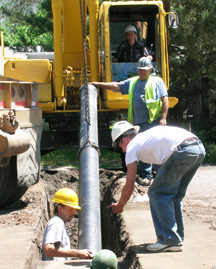
Every aspect of our lives in some way relies on the use of part of the nation's infrastructure. Drawing a glass of tap water, driving to work or turning on the lights in your home all require a vast infrastructure to enable these simple tasks. The Salt Lake City Department of Public Utilities (DPU) is an important part of that system and likewise has the same challenges that the nation faces in coping with an aging infrastructure.
The condition of the nation's infrastructure (Water & Environment, Public Facilities, Transportation and Energy Facilities) has been identified as one the most challenging issues facing America. Age, along with growth-driven expansion and higher federal standards make the infrastructure problem even more daunting.
In 2009, the American Society of Civil Engineers (ASCE) published its score card rating the condition of the U.S. infrastructure. It scored the condition with a “D” grade, noting that decades of underfunding and inattention have “jeopardized the ability of our nation's infrastructure to support our economy.” ASCE recommended that at least $2.2 trillion was needed in 5 year-intervals to adequately fund the necessary improvements to the nation's infrastructure.
America’s drinking water systems face an annual shortfall of at least $11 billion to replace aging facilities that are near the end of their useful lives and to comply with existing and future federal water regulations.
The EPA estimates that $390 billion will be needed over the next 20 years to meet the nation's wastewater infrastructure needs.
All three of Salt Lake City utilities are over 100 years old with substantial number of assets reaching the end of their expected life-cycles, requiring rehabilitation or replacement because of their age. The water utility is one of the oldest in the western U.S. dating back to 1876.
During the period between 1980 and early 1990s, Salt Lake City made major investments to its water infrastructure. Bonding and rate increases funded necessary improvements to the Water Reclamation Plant and sewer collection system under a City Council adopted 201 Facilities Plan; and the construction or reconstruction of major drinking water conveyance systems, dams, water purification plants and distribution reservoirs.
|
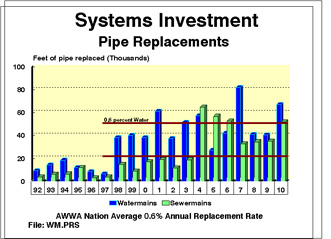
In the early 1990s, the City began to focus on the age and condition of its water and sewer pipes. After intensive study, on June 10, 1997, the City Council approved a 5-year, $45.3 million capital improvements program to upgrade the Water Reclamation Plant treatment process and established a program to replace or rehabilitate annually 0.6 percent of the aging water and sewer pipes. The City Council approved a 15 percent rate increase followed by 7 percent rate increases for each of the next four years to fund the program. Aging sewer pipes are rehabilitated by using Cured-In-Place-Pipe (CIPP) trenchless technology, rather than replacement. Subsequently, the City Council has continued to fund the program, with a goal of replacing or rehabilitating one-percent of the pipes annually.
Since 1997, the DPU has invested $390.2 million in water, wastewater and stormwater capital improvements. The peak expenditure occurred in 2008 with $50 million spent on capital improvements.
Included in this investment is the installation of 217,179 feet of stormwater pipes. Many of these pipes are associated with other projects, including City Engineer, UTA, TRAX, UDOT and in-house projects.
In the current FY 2011- 2012 budget, there are $59.4 million in capital improvements: $17.4 million for drinking water, $29.3 million for wastewater and $12.7 million for stormwater infrastructure.
According to engineering administer Chuck H. Call Jr., two of the largest projects this year are the Folsom Storm Drain and the Orange Street Sewer Rehabilitation projects. The $8 million Folsom Storm Drain project consists of constructing a new box culvert along Folsom Avenue from North Temple to the Jordan River. The new culvert will improve the capacity for run-off flows from the City Creek watershed and drainage from North Temple Street. Collecting sanitary sewage from the City's west side, the existing 50 year-old Orange Street sewerline requires rehabilitation. Located on Orange Street and North Temple, running north on Starcrest to 1100 North and then east to the pre-treatment pump station, the flow is discharged into the Water Reclamation Plant. Costing $10 million, a liner will be installed within the existing sewerline.
Besides the larger projects, DPU will continue to meet its goal of replacing and rehabilitating aging pipes within the three utilities’ systems. Also, added this past year is a new program to replace old valves within the municipal water system, which are located on mains that are not scheduled for replacement, but are inoperative. This year 200 valves will be changed out.
The condition of the nation's infrastructure varies from entity to entity. Over the past three decades Salt Lake City has made the necessary investments to its water, sewer and stormwater utilities to keep pace with growth, more stringent standards and the effects of age.
|
Director Jeff Niermeyer is appreciative of the Mayor and City Council, both in the past and today, for recognizing that the City must continue to invest in renewing its critical infrastructure. “As we look to the future, the utility systems will need continuing funding not only for rehabilitation but also to meet the ever-changing regulatory environment.” Continuing, “ More stringent regulations that are coming both in the Clean Water Act and the Safe Drinking Water Act will be driving our capital budgets and will compete for funds needed to continue a strong capital rehabilitation program. As the availability of funding shrink, the Department will need to find innovative technologies and solutions to meet this challenge,” said Niermeyer.